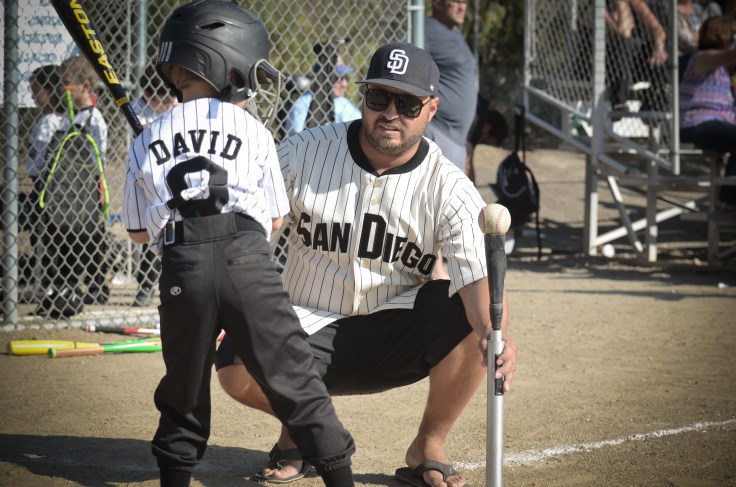
 I’m in the top half of the final inning of my game when I hear my name being shouted from the T-ball field. Sure enough a T-ball coach is waving me over. Confused by the fact that I am clearly in the middle of a game I curiously walk out to meet him.
“I need you to escort a parent off the field.” (I’m a member of the board and in these instances this is one of the unfortunate responsibilities)
I look over his shoulder and see the two teams shaking hands.
“The games over,” I said gesturing to the actions behind him.
“We called the game.”
“Isn’t this T-ball?” I asked perplexed.
“Yes, the father was defiant and endangered the safety of the kids and refused to listen to me. So I told him that I’d have him escorted off by a board member.”
If I have learned anything in this life it is this sad lesson: that whenever anyone gets a little authority it is part of our very nature that we will immediately begin to exercise abuse of that authority.
I recognized three authorities in this situation: (1) the authority of coach, (2) the authority of parent and (3) the authority of me, board member — considering this was T-ball I sensed the source of the problem was an abuse of one authority or another (or both). Now my job was use my authority to stop the abuse. As I listened to the coach relay his concerns I could feel a punitive tone, that someone had not respected his dominion on the field. As I spoke with the father I learned that the coach had offended his parental authority.
They had the same problem: Both were offended by the other’s use of authority. It was a power struggle. Both felt they were in the right. The situation could have been avoided if either of them were willing to use their authority to back down. Because no one did, everyone suffers.
“If I have learned anything in this life it is this sad lesson: that whenever anyone gets a little authority it is part of our very nature that we will immediately begin to exercise abuse of that authority.”
The key to using authority correctly is to first understand the origin of authority. Parental and managerial authority are gifts given. As much as we are grateful to receive it, we cannot forget that we are eligible at anytime to be stripped of it. The moment we begin to think that no one can take our authority away we are in danger of misusing it. For example: as a parent I become too comfortable and begin to think that there is no authority above my own. Then whenever another authority begins to usurp it’s power over my kids I begin to feel the need to take the reigns. A power struggle ensues. Such struggles manifest themselves in World Wars and — now, on record — T-ball games.
How can we avoid this abuse? When talking to the father I invited him to tell me his side of the story. At one point he explained that he, “wasn’t going to back down in front of my kid.” Parental authority is the authority of example. Kids will become their parents. Not wanting to back down from a coach because you want to flex your authority in
front of your kid is the worst example we want to set for kids who are learning to deal with an authority who is not their parent. On the other hand the coach would have been wise to question his/her authority before they went to use it. After my interview I understood that this parent was a T-ball novice and did not comprehend the situation. The coach would have been wise to tread lightly with his authority and with great persuasion, use it to educate rather than alienate.
The purpose of authority is to subdue not antagonize. That’s why we coach. We trust that we are the right person to make the best decisions for player, family, and team. When fear and anger enter the dominion of the baseball field we cease to “play a game,” and commence surviving a battle. Authority is not inherited, guaranteed by title, or certified by paper. Authority comes not by rank but by deed. It must be earned. It is given to you by those who choose to follow. Who cares if your name has the title coach next to it on the banner, you have no authority if players and parents don’t trust you. Every progenitor by nature of biology is given the title of parent; but only those who earn and maintain the trust of their children retain the authority of mother and father. Fatherhood/motherhood does not come by exercising our procreative powers or paternal rights (I’m still waiting for California to pass a bed time law so I can enforce it with authority — I’d vote for that one). Parental authority (and any authority for that matter) comes only by love, gentleness, kindness, long-suffering, persuasion, meekness and an outfield full of patience.
I abused my authority the other day. I misread a pitch-count in the official score book and then approached a coach in the parking lot about pitching one of his pitchers who was ineligible. This accusation not only hurt our relationship, but his older and younger son walked up during the conversation and they believed me over their dad. The results were nothing like I had imagined in my head. Later that night I double checked my notes and learned I was wrong. A great guilt, sorrow and remorse overcame me. I was stripped of authority. Even worse I had abused my authority to strip a father of his patriarchal authority. Later that night I called the coach and apologized. He told me that since our conversation in the parking lot his sons had not talked with him. They thought their dad had cheated. We had a long talk and reconciled. My joy at the end of that conversation was as great as remorse at the beginning. I believed that I had been forgiven and felt authority restored.
One of my favorite “authorities” on this is Steve Springer. He says that any twelve and under baseball has always got to be fun. Our younger players play with unnecessary “tension, pressure and anxiety put on by the one that loves them the most.”
I have seen Parent v. Coach too many times and it seems that neither is backing down. What I have yet to see is a child proud of their parent or coach for getting into a fight in front of their teammates and friends. 100% of the time the child is either scared or embarrassed.
Children want to feel safe. On the field the coach’s job is to protect their safety — not just physically, but psychologically. Once the kids are on the field it’s the parent’s job to submit a portion of their parental authority to the coach. If there is anything in question about the coaches approach, address the coach in private (and treat him fairly — innocent until proven guilty). If you’re still worried address the proper authorities — board members, league president, coaches coordinator etc. Remember: your kid batting ninth is not an abuse of authority. Your kid not playing on the field when there is a mandatory play rule, is an abuse of authority. Understand the rules first. Ask questions about the league policies and division specific rules before accusing coaches/parents. As the player agent I am approached all the time about other coaches. These are wonderful conversations that promote growth and well-being. It opens up a dialogue that benefits all parties. Many times conflicts are avoided because there was a misunderstanding of rules, situations and expectations — as I learned in today’s T-ball incident.
I don’t hang out with or miss the people who have abused their authority in my life. They have not taught me anything but to be afraid of them and to stay away. There are others, however, who I will slave and sacrifice for, because of their authority — the love, kindness, patience that they have demonstrated towards me. Don’t abuse the gift.
 Confessions of a Little League Dad
Leave a comment