0-2
“You’re way ahead,” I said, “keep pounding the zone.”
I knew the batter. He’s a free swinger. Then why did I say “pound the zone” with an 0-2? Too late. The ball flew over the left-center fence. The first homer of the year — crushed.
The shortstop threw his glove on the ground. The pitcher was in tears, the center fielder was in tears, the left fielder’s hat was receiving a beating. Here was my great opportunity to be coach of the year. To impart words of wisdom. To change their lives with a maxim they would never forget — nothing. Nothing came to my mind, because I was crushed too.
We we’re playing my former team. The manager and I had coached together for 4 years and he was taking it out on me. Saving the first two home runs of the season for the game against us. My blood boiled and my heart ached as my friend and former players congregated at the plate and jumped up and down on our hearts — “not fair” I thought, “this is not fair.”
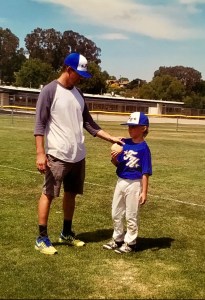
Once in the dugout one of the players said, “I want to be on their team now.” Prior to the second inning we had the best record in the league and we were now in the process of being dethroned. I questioned the player, “What did you say?”
“I was just kidding coach,“ he redacted.
But I had to pull the beam out of my own eye, I wanted to be on their team too. I was every bit the 9 year-old boy that my players were.
I didn’t sleep that night. I lay in bed with my eyes closed but my mind was chained and shackled with pride. With the help of some melatonin I finally fell asleep at 5am (fortunately I didn’t have to be at work until 11am).
The next day I was talking with my son (the shortstop who’s glove was on the ground) about the game. He was not disappointed in the home run, but in the player who hit it. My son has been dreaming of hitting a home run since he could say the word. Unfortunately since he was five he has been the smallest player in his division. My son feels he’s an above average player. It is our nature as athletes to compare ourselves with others. We in turn classify other players either above or beneath us. I think every little boy and girl who has ever played sports has gone through this experience. But what happens when a mediocre player makes an above average play? What happens when someone busts the draft and exceeds expectations? In this instance my son was not devastated by a home run. He was devastated that someone he deemed mediocre hit it. Thus the mighty are confounded by the weak.
How do we avoid such confoundment? Being happy for another’s success is something I believe in with all my heart … It is also something that as a 39-year-old I struggle to execute. But I also believe in being crushed. We are surprised when the weak make strong plays. We are devastated when the strong commit errors. When opposites occupy the same space — in this case weak and strong — we reveal a paradox.
Paradox is essential for the deepest levels of learning. I read a book 20 years ago in college called The Courage to Teach. It’s one of the few books that I still have from my college library. Twenty years later I decided to pick it up and read it again — light poured from it’s pages as twenty years of life have given me new eyes to see. In the book Parker Palmer explains the relationship between Paradox and Learning:
“We distort things all the time . . . because we are trained neither to voice both sides of an issue nor to listen with both ears. The problem goes deeper than the bad habit of competitive conversations some of us have: tell me your thesis and I will find any way fair or foul to argue the other side! It is rooted in the fact that we look at the world through analytical lenses. We see everything as this or that, plus or minus, on or off, black or white; and we fragment reality into an endless series of either-ors. In a phrase, we think the world apart.”
Thinking the world apart . . . has given us great power. . . Without binary logic we would have neither computers nor the gifts of modern science.
But for all the power it has given us in science and technology, either-or thinking has also given us a fragmented sense of reality that destroys the wholeness and wonder of life. Our problem is compounded by the fact that this mode of knowing has become normative in nearly every area, even though it misleads and betrays us when applied to the perennial problems of being human that lie beyond the reach of logic.
How can we escape the grip of either-or thinking? What would it look like to think the world together? Not to abandon discriminatory logic where it serves us well, but to develop a more capacious habit of mind that supports the capacity for connectedness on which good teaching depends.
Niels Bohr the nobel prize winning physicist offers the keystone, “The opposite of a true statement is a false statement, but the opposite of a profound truth can be another profound truth.”
With a few well chosen words Bohr defines a concept that is essential to thinking the world together– the concept of paradox. In certain circumstances, truth is found not by splitting the world into either-ors but by embracing it as both-and. In certain circumstances truth is a paradoxical joining of apparent opposites and if we want to know that truth then we must learn to embrace those opposites as one.
In the empirical world, as Bohr makes clear, there are choices to be made between true and false, choices that must be informed by fact and reason. . . .
Bohr also affirms another realm of knowing where binary logic misleads us. This is the realm of profound truth, where if we want to know what is essential we must stop thinking the world into pieces and start thinking it together again. Profound truth rather than empirical fact is the stuff of which paradoxes are made.”
“. . . holding paradox means thinking about some (but not all) things as “both-ands” instead of “either-ors (The Courage to Teach, pg. 61-62).”
In my son’s eyes you are either a good player or a bad player. Such an either-or view is not only crippling — but dangerous. Forgive him, me and all of us for thinking this way. In the spirit of competition it’s how we make most of our decisions. But it’s not impossible to view the game in other ways. For example you will never underestimate your opponent if you can learn to think them as both-and — both not as good as you and able to beat you. Thinking this way allows for them to hit home runs and for you to recover against the next batter. It’s the Wreck-it-Ralph paradox, “I’m bad, and that’s good. I will never be good, and that’s not bad. There’s no one I’d rather be than me.”
Back to the game . . .
After we got pummeled I confided in the kids, “That was hard.” As I looked them in the eyes I realized they didn’t seem to think so. The tears and disappointment were replaced with giggles and goofiness. As I looked around I they almost seemed happy. Only a few had the solemn look of defeat in their eyes. What at first gave me hope quickly turned to despair. The happiness was not an embracing of paradox, rather they had traded their devastation for apathy — they had traveled down the road of either-or. I could hear them claiming to the other, “I don’t care that we loss.” “We still have the same record as they do, so it doesn’t matter.” Scarier that then loss was the sudden apathy that distilled on the huddle — If I don’t care then it can’t hurt. Apathy comes from the french word apathie, “freedom from suffering, passionless existence.” This was the scariest revelation of the loss. The paradox of playing a sport is feeling both pain and joy. It has to hurt and we need to be brought down to the dust of the infield. Without the hurt there is no learning. We do not learn repentance. We feel no drive to get better. No respect for our opponent. No pain to inspire sacrifice. For this reason I have always believed the team with a 6-5 record learns more than the undefeated 11-0 team. One teams endures the paradox of both winning and losing while the other team faces no real opposition.
In certain circumstances truth is a paradoxical joining of apparent opposites and if we want to know that truth then we must learn to embrace those opposites as one.
–Parker Palmer
A few days ago my other team played the number one seed for an automatic bid to the championship game. Our opponent had not lost all season. Five innings later we were victorious. Opposing coaches and players were shocked. After the game the other coach approached me.
“You know that was our first loss?”
I knew, but I didn’t feel sorry. His approach to the whole season has been an either-or approach. Either win or lose. If you win you’re a good team. If you lose it’s because you played badly. I understand the tendency towards this philosophy — it drives much of the world we live in and it has driven me in many instances. But lately I have embraced another paradox: to learn requires both winning and losing.
This season I have worked hard to have a both-and mentality. To play the game in paradox. I needed to help our kids both win and lose. I never lost the game on purpose, nor did I try to win the game on purpose. If we won it was because the top and bottom half of the team played a role. My end of game speech this whole season has always started with, “I need a team set of game balls.” In every game there are multiple players who exceed expectations. But this has come through a series of failures and losses. With the win the other night we broke the .500 mark 6-5-1. Through the lessons and emotions of winning and losing our players have gained confidence. We are getting better at keeping the head and the heart whole. As a manager this has been gut wrenching, it means I have to play players in key situations and positions when they are not the best option. The pay-off has been nothing short of miraculous.

There is humiliation and then there is humility. I realized, in the first example, that the loss to my former team spawned tears of humiliation not humility. Humiliation is driven by individual pride of self, humility is driven by a love and desire for team, coach— in other words, a sacrifice of self. I don’t know how to teach humility. It’s not something learned from a book. It must be learned when the sun rises after the darkness of defeat. But if you exile the pain of defeat in apathetic mockery then we do not learn the lesson hidden in the loss — as if the loss never happen. We continue to hide our sins and weakness instead of learning to confront it. Learning to embrace mediocre players playing well, embracing both losses and wins. When we can both win and lose we will find the hidden joy that makes this game and life beautiful. We learn that it is good to be crushed.
 Confessions of a Little League Dad
Leave a comment