The following works best if you identify a problem you are having a hard time solving. List all the different parts to the problem. At the conclusion of this lesson you will return to your problem.
It comes from an Old German word meaning “piece cut off; mutilated, blunt or dull.” Around the time Joseph Smith was born American’s began using it to describe what it feels like to be “baffled or brought to a halt by obstacles or impediments.” To this day if we are unable to explain or answer something we are stumped.
Thousands of years ago Isaiah used the image of a stump to teach about the final days preceding the millennium.
And there shall come forth a rod out of the stem of Jesse, and a Branch shall grow out of his roots
Isaiah 11:1
A more recent English translation of this verse reads:
A shoot shall come forth out from the stump of Jesse, and a branch shall grow out of his roots.
Isaiah 11:1 New Revised Standard Version Bible
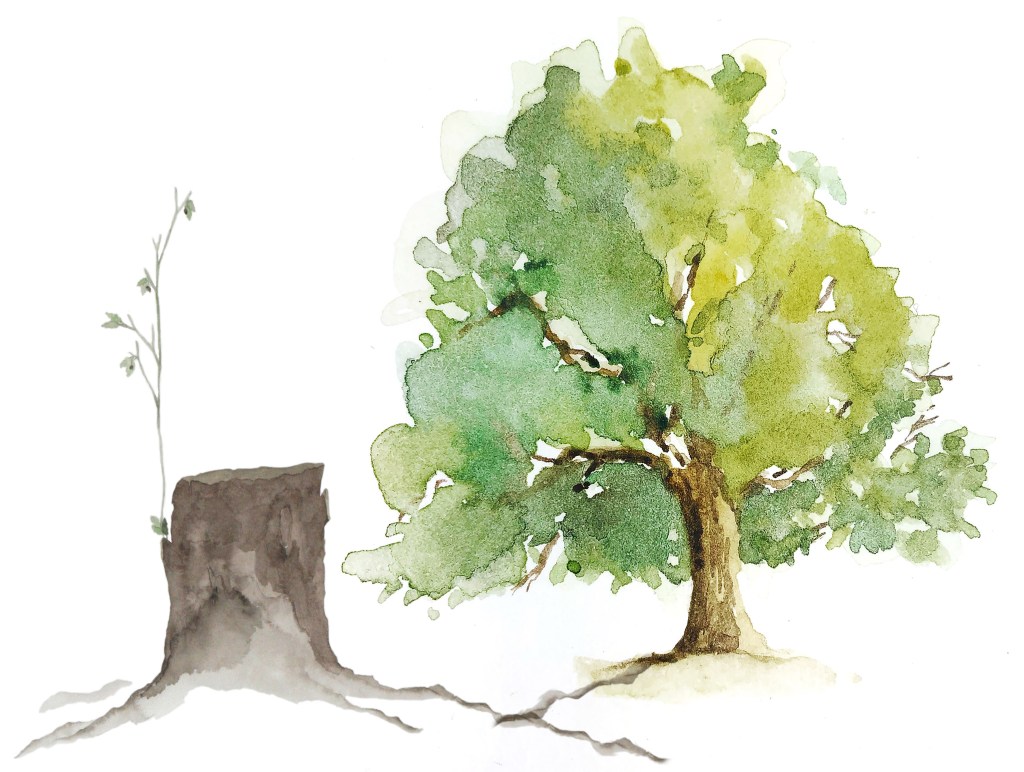
When Joseph Smith was 17 years-old, he was stumped by his sins. He knew that he was called of God, and yet he was not making good choices. He prayed for forgiveness and the angel Moroni appeared. Of the many things Moroni taught Joseph that night he, quoted Isaiah Chapter 11 saying it was about to be fulfilled (see JSH 1:40).

How are these verses supposed to comfort a confused teenager?
Twenty-five years later Joseph was stumped for different reasons.
“Persecution, apostasy, dissent, and bankruptcy plagued Joseph in 1837. A Church-sponsored joint stock company called the Kirtland Safety Society, . . . failed. Several of Joseph’s close associates turned against him. Most of the Saints sustained Joseph, but as many as three hundred were disfellowshipped or excommunicated. Among them were leading elders—apostles, seventies, Book of Mormon witnesses, Joseph’s secretary.”
“Joseph’s enemies pursued civil and criminal lawsuit actions. Joseph was tried and found guilty of violating Ohio’s banking laws. He was charged with attempted murder and was acquitted. There was no peace, no rest, in Kirtland, Ohio. It seemed that with the bestowal of priesthood keys (D&C 110) concerted opposition overwhelmed the Saints.”
Making Sense of the Doctrine & Covenants, Steven C. Harper
The Lord commanded Joseph and his family to flee with others to Missouri. Along the way Joseph was asked by his traveling companions to clarify some passages in Isaiah, including Chapter 11. Joseph had learned much since that night with Moroni. Joseph’s responses were significant enough that they were recorded in Doctrine and Covenants 113.
Read verses 1-6 of section 113 and identify the different pieces of the imagery:
Stem (stump) of Jesse
Rod (shoot)
Root of Jesse
Why is a fallen tree a good last-days image of Jesus Christ?
Out of the roots grows a branch or a new tree. This new tree is Christ’s kingdom at his Second Coming.
How does the interpretation of the roots described in verse 6 make the second coming possible?
Who is the “servant in the hands of Christ?”
Scholars and Prophets have declared that certainly Joseph Smith qualifies to be this servant. But since the servant described in Doctrine and Covenants 113:3–4 goes unnamed, the door is left open to broader interpretation. At the broadest scope we are all capable of qualifying for the role of the rod.
Use footnote 4b to define “much power” that is laid upon the servant?
Whether we are the rod or benefit from “holding to the rod”, how do you use this power in your temple service and in your relationships with your peers?
How can something grow out of something that appears to be dead?
Elder Jeffrey R. Holland, acknowledges that Isaiah 11:1 is “one of the most important passages in all of Isaiah” for Latter-day Saints because it “is rich with nuances of the Restoration.” “[T]he restoration of the gospel . . . is like the new shoot out of the old stump, and we see the fruits of those labors in—and with—Zion (Jeffrey R. Holland, “‘More Fully Persuaded’: Isaiah’s Witness of Christ’s Ministry,” in Isaiah in the Book of Mormon, 12).” Though Christ died (stump) he was made alive and now his power is restored in the rod and the roots.
This is the strength of Zion
In D&C 113 Elias Higbee asked questions about Isaiah 52:1-2.
Study verses 7-10 looking for answers to the following:
What is the strength of Zion?
What is the promise to those who return to the Lord?
The curses of God is the bondage we feel when we are not entirely faithful. Think of areas of your life where you might feel the bondage of anger, pride, or apathy. Pray for ways to increase your faith in these areas. Write them down and commit to increase your faith. Look for evidence in the future weeks of the “bands of thy neck” having been loosed.
D&C 113:10 invites us to study Isaiah 52:6-8. What do we learn about revelation from these verses?
Return to your problem
What is the role of the Savior in your problem?
As you have studied, what feelings and or impressions have you had about how to overcome this challenge?
How can you apply the principles of the salvation, restoration, priesthood, and revelation to your problem?
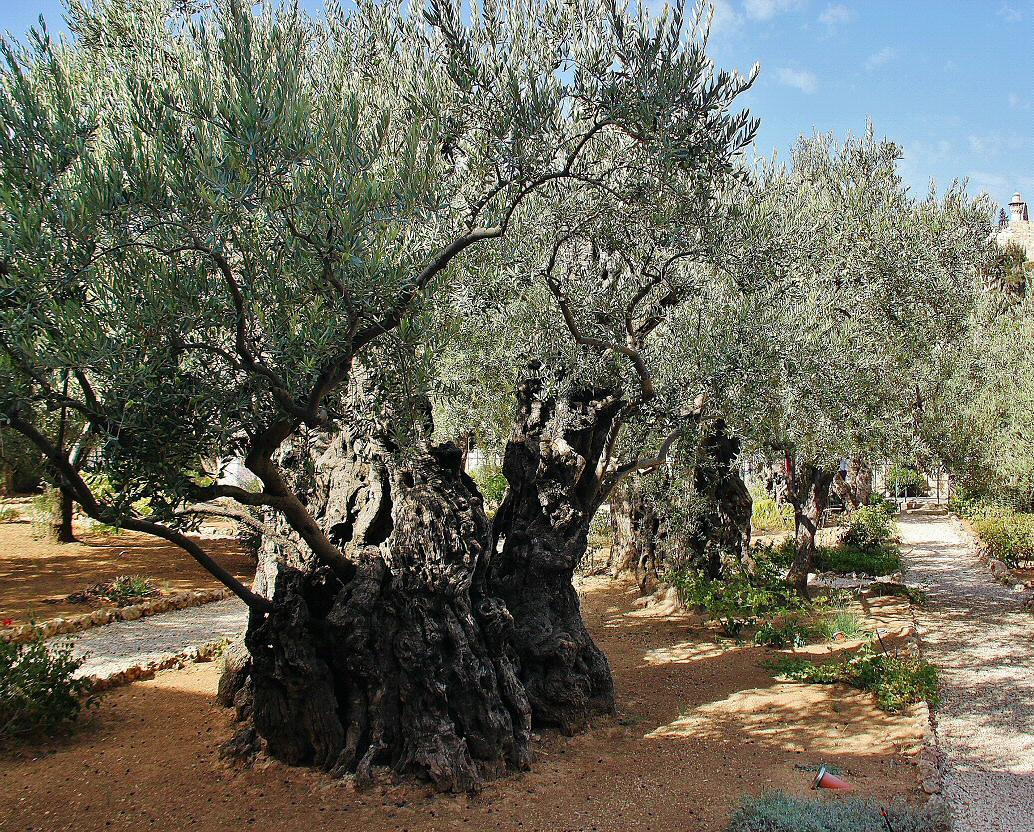
Ann Madsen points out that shoots growing from stumps is rather normal in the land of Israel. She says, “In Jerusalem it is common for such stumps to sprout and grow (one whole garden of such fruitful stumps is called Gethsemane) (“Joseph Smith and the Words of Isaiah,” in Isaiah in the Book of Mormon, 355).” One of the purposes of life is to come to earth to be stumped. In these moments we learn to rely on the “Stem of Salvation,” Jesus Christ. As Latter-day Saints we also look to the exemplary “servant in the hands of Christ,” the “Rod of Restoration,” Joseph Smith. As we enlist to be such servants our individual deliverance grows a new branch that serves as an ensign to the world that living things can grow from that which was thought dead.
Several thoughts and quotes on this topic were inspired by the following publication:
The Stem of Salvation and the Rod of Restoration | Revisiting Biblical Exegesis and Latter-day Saint Interpretation of Isaiah 11:1 By Jared A. Jepson
 Confessions of a Little League Dad
Leave a comment