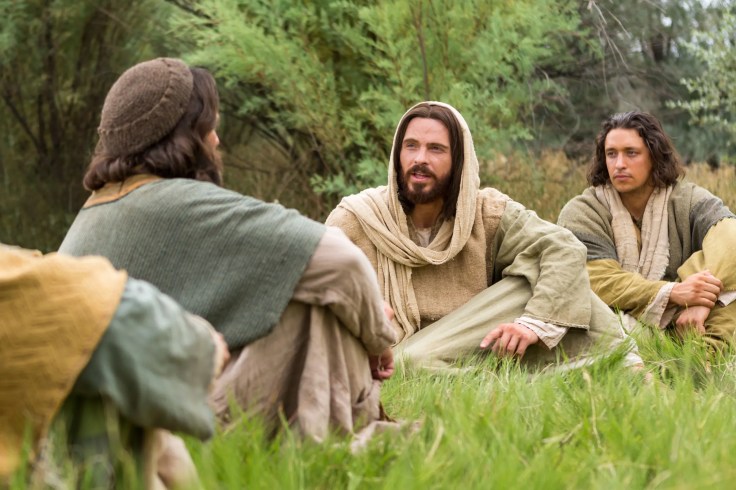
The Savior Provided Opportunities for People to Be Taught by the Holy Ghost
In Teaching the Savior’s Way we read,
“It was difficult for many in Jesus’s time to understand who He really was, but there were plenty of opinions. ‘Some say that thou art John the Baptist,’ His disciples reported, ‘some, Elias; and others, Jeremias, or one of the prophets.’ But then Jesus asked a question that invited His disciples to set aside the opinions of others and look inside their own hearts: ‘Whom say ye that I am?’ He wanted them to find their answer not from ‘flesh and blood’ but directly from ‘my Father which is in heaven.’ It was this kind of witness—personal revelation from the Holy Ghost—that enabled Peter to declare, ‘Thou art the Christ, the Son of the living God’ (see Matthew 16:13–17).”
“Flesh and Blood” Questions
The Savior knew that there were two kinds of questions. Questions that had “flesh and blood” answers and questions that required greater light and knowledge from our “Father in heaven.”
A “flesh and blood” question invites opinions, factoids, and information that can be gathered from a variety of earth bound sources. These questions are useful to help establish the current understanding of the world as well as the understanding of it’s people.
An inspired question requires the teacher and the learner to abide by the principles that govern revelation. To answer such questions may require additional searching of the scriptures, individual repentance, or a period of stillness and prayer.
“To survive spiritually in the latter days, the people you teach will need a spiritual witness of the truth. You can’t give it to them, but you can invite, encourage, inspire, and teach them to seek it. You can make clear—through your words and actions—how crucial the Holy Ghost is to gospel learning.” Teaching the Savior’s Way
Model


See if students can make the connection to Aaron Judge’s 62nd home run hit last year to break Roger Maris’ single season Home Run record for the Yankees. If they can’t make the connection, or if someone makes the connection, reveal the following picture:

Reveal the following principle for the students:
“knowing the history of an object can increase our understanding of its value.”
STEP II: THE INSPIRED QUESTION
Image 1.2
The curriculum then suggests displaying an image of the Savior and asking the question, “How might understanding who Jesus Christ was before His birth help you understand the value of His life and mission on earth?” (Image 1.2)
Later in the curriculum they invite students use John 1:10-11, looking for difficulties the Savior endured on earth and why.
One way to invite the Spirit to witness the infinite value of the Savior’s life is to combine these two pieces into an inspired question.
After revealing the principle above invite students to turn to John 1:10-11. Have a student read it out loud. Then display the following picture of Jesus Christ explain that men and women in Jesus’ time rejected him. Then invite the class, pointing to the picture,

“Take a moment to think about the history, premortal and mortal, of Jesus.
What about His history moves you to receive and value Him?”
Observe the clock and allow a minimum of 30 seconds before you allow students to share their responses.
After listening to the students responses ask a follow-up question: “why do you think it is easier for some people to value a home run ball more than the life, teachings, and Atonement of Jesus Christ?
Use the rest of John 1:1-16 to build on the witness established by the inspired question. Doing it this way allows you to understand the current state of students and teach at their level and understanding.
 Confessions of a Little League Dad
Leave a comment