
“If you hesitate in this adventure because you doubt your ability, remember that discipleship is not about doing things perfectly; it’s about doing things intentionally. It is your choices that show what you truly are, far more than your abilities.”
Dieter F. Uchtdorf
We all have different reasons we play the game. Some want to hit. Others want to pitch. A chosen few like to steal. Most play to win. But what of managers? I wonder if they want to play because they like to make choices.
In the off season we love to analyze the physical abilities of players. We dote over a physical specimen or gloat over an undersized overachiever. But inevitably we will spend most of our time and energy discussing one thing– choices made throughout the game. While we are enamored by the physical traits of our sports heroes, legends are made when their cunning surpasses their capacity.
Each year little league coaches sit for hours assessing the ability of players. We measure their strength, size, glove work and speed. Certainly, velocity and power will merit a high draft pick, but winning often comes down brains, not brawn—sometimes the difference between winning and losing is a single choice. And this is the summun bonum of the draft. Physical ability is no mystery. The secret to a good draft is, who can make the winning choice?
My son’s middle name Dieter, comes from Dieter F. Uchtdorf. As a young boy Dieter had to flee East Germany during WWII. He grew up to become a decorated pilot and senior vice president of flight operations for Lufthansa. He is currently one of the twelve apostles for the Church of Jesus Christ of Latter-day Saints. Recently he said, “If you hesitate . . . because you doubt your ability, remember that discipleship is not about doing things perfectly; it’s about doing things intentionally. It is your choices that show what you truly are, far more than your abilities.”
When I scout players, my goal is to observe intention. The problem with tryouts is that they only test ability—players field five ground balls, five pop flies, five pitches, five swings and in the end make very few choices. In the few minutes we have, I try and watch them make as many choices as possible. I look at the way they stand in line and wait their turn. I observe their reaction to the pressure and failure of others as well as their own. I look for their parents in the bleachers and try and read their relationship. Yet despite my best effort I know we won’t know who they truly are until we watch them make choices in the game.
“It is your choices that show what you truly are, far more than your abilities.”
Dieter F. Uchtdorf
In the first four games of this season, I have learned that we have players full of ability. I have also learned that there are moments where their ability has been stymied by doubt. Outfielders, so paralyzed by fear of the ball getting past them, they refuse to run up on any ball that has less than 100% chance of being caught. Outs are dropping for base hits not because of inability, but because of doubt. Hitters are filled with fear inhibiting their ability to take the bat off their shoulder. Obviously if the player is making the right choices, but lacks ability, then we work on improving ability. But if a player is making the wrong choices, then no amount of ability is going to compensate. We must help our players rid themselves of doubt and fill them with the power to play with real intent.
Choices Reveal Intent
When I witness a player giving up on a fly ball it reveals their intentions. Intention is the hardest thing to change; and change is the hardest thing to coach. I want players doing things intentionally; if I see the correct intention, then I don’t mind imperfection. Manual labor will amend inability– the baseball gods love effort. But the mental exertion required to amend intention is far more demanding. Umpiring a game on Saturday I watched an 8-year-old charge in on a bloop to right field. He dove and the ball made it in his glove only to pop out when he hit the ground. The other team was ecstatic as the batter slid into second. I was ecstatic because an 8-year-old had more courage than most of the 12-year-olds in majors. This 8-year-old was playing with nine, ten and eleven-year-olds. He was tiny– a David among Goliaths. But I couldn’t take my eyes off him. At the plate he swung at pitches outside of the zone and made contact every time. His intent was to hit and anything he felt he could connect with, he swung at— he wasn’t waiting for the perfect pitch, he was waiting for hittable pitches. He never struck out. Where did he come from?
How do we develop or change intention?
“In philosophy, intentionality is the power of minds and mental states to be about, to represent, or to stand for, things, properties and states of affairs (Stanford Encyclopedia of Philosphy).” It is the idea that the mind is like a mental bow whose arrows can be aimed at different targets. When Mike Trout sees a baseball hit to the gap his mind sees it as a target to make a diving play. Intentionality is shaped by our beliefs and Mike Trout is full of belief. Thus, when I watch players make their choices, I am trying to measure what they believe in. If we believe our doubts, then our intentions will follow. A player full of doubt has lost the ability to make the winning choice.
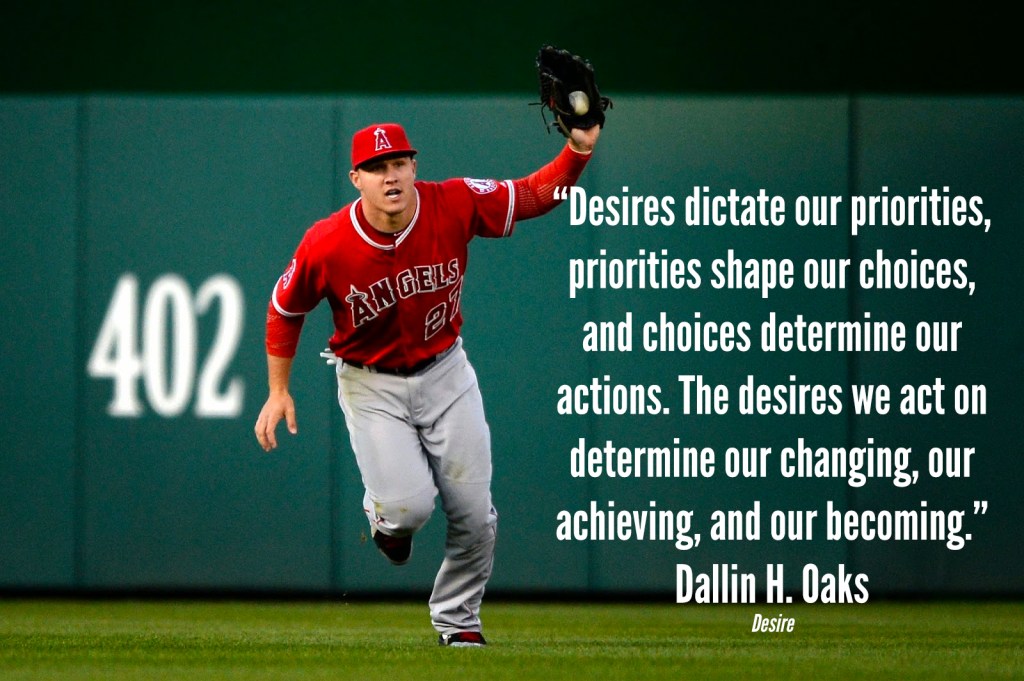
Dallin H. Oaks (my older son’s namesake) once said, “Desires dictate our priorities, priorities shape our choices, and choices determine our actions. The desires we act on determine our changing, our achieving, and our becoming.” Doubt has a tremendous effect on our desires. Thus, to change the choices my players make, I must change the desires my players have. How do you change desire?
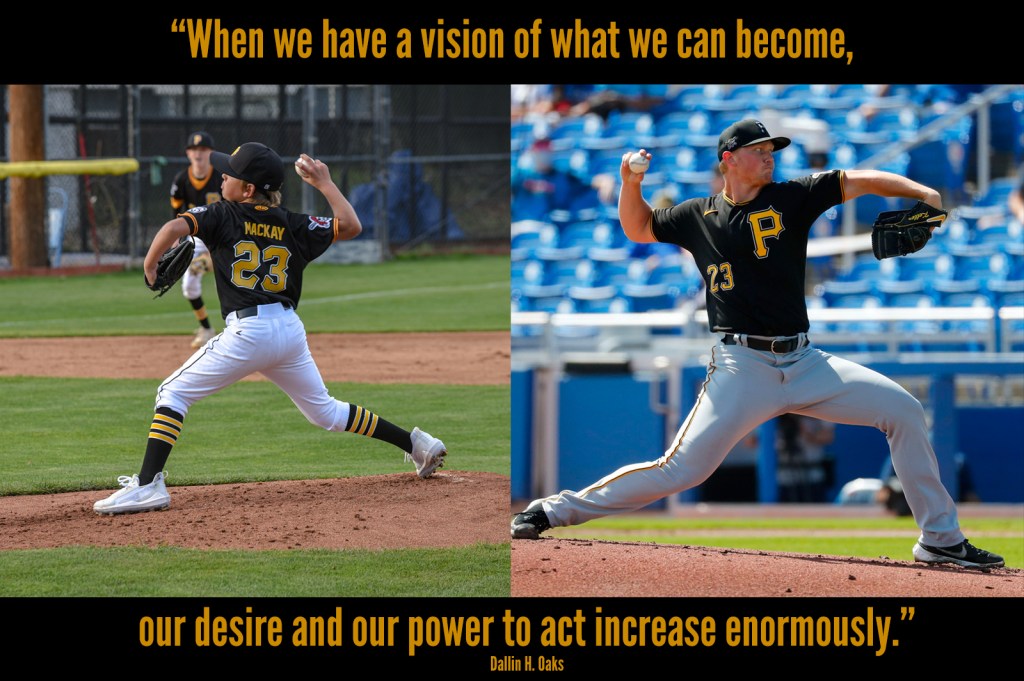
“Few will have the kind of crisis that motivated Aron Ralston, but his experience provides a valuable lesson about developing desires. While Ralston was hiking in a remote canyon in southern Utah, an 800-pound (360 kg) rock shifted suddenly and trapped his right arm. For five lonely days he struggled to free himself. When he was about to give up and accept death, he had a vision of a three-year-old boy running toward him and being scooped up with his left arm. Understanding this as a vision of his future son and an assurance that he could still live, Ralston summoned the courage and took drastic action to save his life before his strength ran out. He broke the two bones in his trapped right arm and then used the knife in his multitool to cut off that arm. He then summoned the strength to hike five miles (8 km) for help. What an example of the power of an overwhelming desire! When we have a vision of what we can become, our desire and our power to act increase enormously (Desire, 2011).”

If we are to rid our players of doubt, we must replace it with a more powerful belief. When they have a vision of what they can become, then their “desire and power to act increase enormously.” This is the mystery of all great coaching. Present them with a vision that they can believe in—then work with them to exercise that belief.
Warning
Coaches can relieve a player’s doubt or he can be the source of them. If a player is afraid of the reaction of coaches, teammates, or parents then we become sources of their doubt. They loose the freedom to choose for themselves. I am emphatic with my players that coach will never be disappointed by lack of ability or an attempt to make the right choice. Your teammates and our staff love effort– that is all we ask for. Coaches must be the source of belief, not a source of doubt.
Sometimes it’s hard to see victory without seeing one team “out-ability” the other. But always the most important wins are based on one team “out-choosing” the other. This is why we play sports– to learn how to make choices. When you choose the right more than you choose the wrong, the natural consequence is winning.
 Confessions of a Little League Dad
Leave a comment